
info@gillpestworks.com.au | Trading Hours: Mon – Fri: 7:00 AM - 6:00 PM, Sat: 7:00 AM - 6:00 PM info@gillpestworks.com.au | Trading Hours: Mon – Fri: 7:00 AM - 6:00 PM, Sat: 7:00 AM - 6:00 PM
Gill Pestworks Blog

How Long Can Cockroaches Survive Without Food or Water?

10 Sep 2026

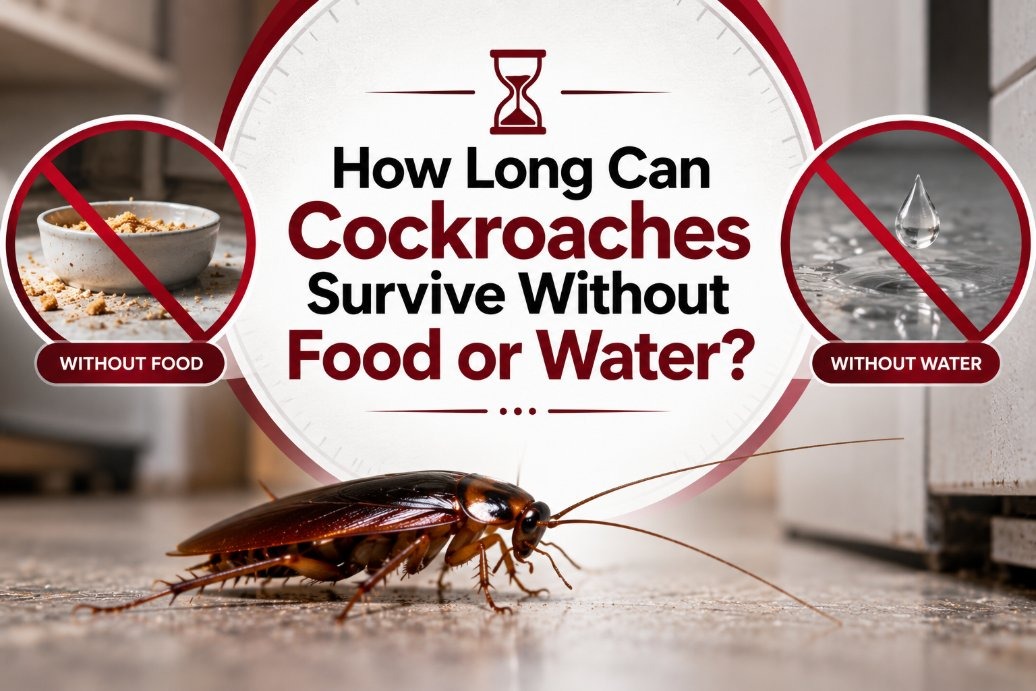
Cockroaches can survive roughly a month without food and about a week without water, which explains a lot about why they’re so notoriously difficult to get rid of. If you’ve ever tried to starve one out by cleaning obsessively for a few days, only to spot it again a week later, this is exactly why that approach rarely works on its own.

Understanding just how resilient these pests actually are helps explain why professional cockroach treatment in Officer focuses on elimination rather than simply removing food sources. Here’s a proper look at cockroach survival, what makes them so hardy, and why waiting them out is almost never a realistic strategy.

Why Cockroaches Can Go So Long Without Eating

Cockroaches have an incredibly slow metabolism compared to most insects, which means they burn through stored energy far more gradually than you'd expect. A cockroach's body is built to conserve resources, slowing down its bodily functions considerably when food becomes scarce rather than rushing to find more straight away.

This adaptation traces back millions of years, long before humans existed to leave crumbs on kitchen benches. Cockroaches evolved in environments where food wasn't always guaranteed, and that evolutionary history is exactly why a month without eating barely registers as a crisis for them.
What Happens When Water Runs Out

Water matters far more to a cockroach's survival than food does, and that's precisely why they can only last around a week without it. Their bodies rely on a certain level of hydration to keep basic functions running, and dehydration sets in far faster than starvation ever would.

This is actually useful information from a homeowner's perspective. Cockroaches gravitate toward moisture sources like leaking pipes, condensation around air conditioning units, or damp areas under sinks, which means fixing these small leaks removes one of the few genuine vulnerabilities they actually have.

Can Cockroaches Really Survive Without Their Head?

This one sounds like an urban myth, yet it's surprisingly accurate. A cockroach can technically survive for around a week after losing its head, since it breathes through small holes along their body rather than through their mouth, and their nervous system doesn't rely on a centralised brain the way ours does.

Eventually, though, the lack of a mouth means they can't drink, and dehydration is ultimately what finishes them off. It's a strange fact, but it reinforces just how differently cockroaches are built compared to most pests homeowners deal with, and why standard assumptions about killing them don't always apply.

Why Starving Them Out Doesn't Actually Work


Given everything above, it's easy to see why simply removing food from the kitchen bench isn't enough to solve an infestation. A month is a long time for a cockroach to hold out, and most households can't realistically maintain a completely food-free environment for that long anyway.

Beyond that, cockroaches don't need much to sustain themselves. Crumbs, grease residue, pet food, and even glue on cardboard packaging can provide enough nutrition to keep a colony going well past the point most homeowners assume they've cut off the supply. Cockroach control in Officer needs to address the actual colony, not just the visible food sources scattered around a kitchen.

How Cockroaches Find Food and Water So Efficiently

Part of what makes cockroaches so resilient comes down to how efficiently they locate resources in the first place. They're equipped with highly sensitive antennae that detect moisture and food particles from a considerable distance, allowing them to track down even the smallest crumb or the faintest trace of condensation.

This sensory advantage means that even a seemingly spotless kitchen can still support a hidden population, provided there's some source of moisture nearby, whether that's a leaking pipe, a pet's water bowl, or condensation building up behind an appliance. Residential cockroach control in Officer typically involves identifying these overlooked moisture sources as part of a broader inspection, rather than assuming visible cleanliness tells the whole story.

Why Professional Treatment Targets the Colony, Not Just Individuals

Given how long cockroaches can survive and how efficiently they locate resources, killing the handful you actually see barely dents the underlying population. A colony can easily include dozens, sometimes hundreds, of individuals hidden away in wall cavities, behind appliances, or within roof voids, well out of sight from anyone going about their day.

A cockroach exterminator in Officer typically uses gel baits specifically because of this survival trait. Baited roaches carry the poison back to the colony before dying, which means the treatment reaches individuals that were never directly seen or sprayed. This approach accounts for their resilience rather than assuming a quick surface-level treatment will be enough.

Signs a Colony Has Outlasted Your Cleaning Efforts

If you've been diligently cleaning for weeks and cockroaches are still turning up, that's a strong sign the colony has outlasted the food restriction rather than genuinely gone away. A few signs point toward this specifically:

  • Sightings continuing well beyond a month of consistent cleaning
  • Droppings still appearing in the same hidden spots
  • Cockroaches spotted during the day, suggesting overcrowding in their hiding area
  • A persistent musty odour that hasn't reduced despite cleaning

At this stage, professional cockroach treatment in Officer becomes genuinely necessary, since their natural resilience has already outpaced whatever food-removal strategy was being relied on.

Finding Cockroach Treatment Near Me When Prevention Alone Isn't Enough

Prevention still matters, and fixing leaks, sealing cracks, and reducing clutter all genuinely help reduce the likelihood of an infestation taking hold in the first place. That said, once a colony has already established itself, searching for cockroach treatment near me is a far more realistic path forward than continuing to wait them out.

Professional cockroach control in Officer accounts for exactly the kind of resilience covered here, using methods designed to reach an entire colony rather than relying on the assumption that cockroaches will eventually give up and move on somewhere else.

Final Thoughts

Cockroaches are built for endurance in a way most household pests aren't, surviving weeks without food and holding on for days even without water or, bizarrely, a head. That resilience is exactly why cleaning alone rarely resolves a genuine infestation, and why a more targeted approach is usually needed to deal with the colony driving the problem. Gill Pestworks understands this biology well and builds treatments around it, giving homeowner clients a genuine solution rather than a temporary fix that a resilient colony can wait out.

FAQs

Frequently Asked Questions

How Long Can a Cockroach Survive Without Food? +

Roughly a month, thanks to their slow metabolism and ability to conserve energy far more efficiently than most insects.

How Long Can a Cockroach Survive Without Water? +

About a week, since dehydration affects them far more quickly than starvation does.

Is It True Cockroaches Can Survive Without Their Head? +

Yes, for around a week, since they breathe through holes along their body rather than their mouth, though they eventually succumb to dehydration.

Why Doesn't Cleaning Alone Get Rid of a Cockroach Infestation? +

Cockroaches can survive on minimal food and hidden moisture sources for extended periods, meaning a colony can easily outlast a few weeks of thorough cleaning.

How Does Professional Treatment Account for How Resilient Cockroaches Are? +

Gel baits are carried back to the colony by individual roaches, reaching hidden populations that a surface-level clean or spray would never touch.